Sole Trader vs Company Australia: Which Structure Is Better?
Updated: 3 days ago
Choosing a business structure is one of the first big decisions you make as a business owner. It can affect how you are taxed, the amount of paperwork you handle, what happens if your business encounters trouble, and how easy it is to grow later.
For many business owners, the sole trader vs company Australia decision comes down to tax, personal liability, setup costs, compliance and future growth.
For small business owners in Sydney, especially in Rockdale, Kogarah, Hurstville, Wolli Creek, and the St George area, the right structure depends on your risk, income, growth plans, and how much admin you are ready to manage.
If you want tailored guidance for your own situation, our Business Structure Advice Sydney page explains how Adenix helps business owners choose the right setup.
This guide explains the key differences between a sole trader and a company in Australia, including tax, liability, setup costs, compliance, and growth. The goal is to help you understand which structure may suit your business before making a decision.
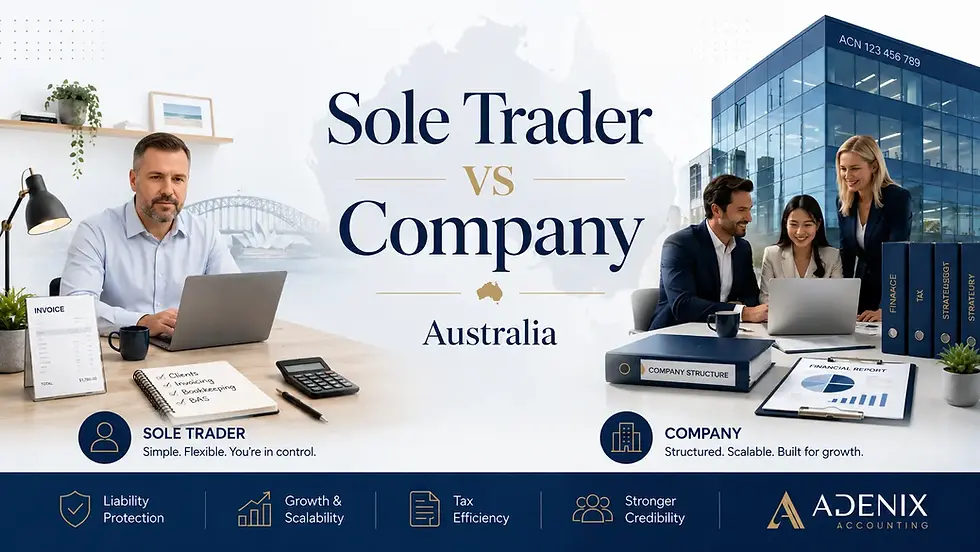
Sole Trader vs Company Australia: What Is a Sole Trader?
A sole trader is the simplest business structure in Australia. I run the business as an individual, which means I keep full control. However, I am also legally responsible for the business, including its debts and losses.
The Australian Government explains this clearly in its guide, " The Difference between a sole trader and a company.
For many people starting out, this is the most straightforward option. It is common for freelancers, consultants, tradies, solo service providers, and people testing a business idea before growing further.
What is a Company?
A company is different because it is a separate legal entity from me. This means the company can own assets, enter contracts, and take on debts in its own name.
If you want the official definition, see this article: Choose your business structure.
This structure is often chosen by business owners who want more separation between personal and business risk, plan to grow, or want a structure that may be more suitable for adding shareholders or building a larger operation.
Issue | Sole trader | Company |
Legal structure | You and the business are legally the same | The company is a separate legal entity |
Setup cost | Usually lower | Higher setup and ASIC registration |
Tax | Business income is taxed at individual rates | The company pays company tax and has no tax-free threshold |
Personal liability | You are personally responsible for business debts | More separation, but directors still have duties |
Admin | Simpler | More compliance and reporting |
Growth | Good for starting small | Better suited to scaling, staff, investors or higher risk |
Best for | Freelancers, consultants, tradies, side hustles | Growing businesses, higher-risk work, larger operations |

When a Sole Trader Structure May No Longer Be Enough
Many Australian businesses start as sole traders because they are simple, affordable, and easy to manage in the early stages. For freelancers, consultants, tradies, creatives, and side hustlers, that can be the right starting point. But as the business grows, the structure may need to change.
Taking on staff, signing larger contracts, buying equipment, working with higher-risk clients, or making stronger profits can all be signs that it is time to review whether a company structure is more suitable.
At Adenix Accounting, we help Sydney business owners review whether their current structure still fits their tax position, risk level, cash flow, and growth plans.
The Biggest Difference: Personal Liability
This is usually the first issue I think about.
As a sole trader, there is no legal separation between you and the business. If the business runs into debt or legal trouble, I am personally responsible.
The government states this directly in the Difference between a sole trader and a company.
With a company, the business is a separate legal entity. This generally gives more protection to my personal assets than a sole trader structure. That is one of the main reasons many owners switch to a company as risk, revenue, or complexity grows.
That does not mean a company removes all personal responsibility in every situation. Directors still have duties and obligations. ASIC explains those responsibilities in ASIC business basics.
Set up is Easier and Cheaper for Sole Traders
If your priority is getting started quickly and with low cost, a sole trader is usually the easier path.
According to the Australian Government, sole traders generally have fewer setup costs. An ABN is free, and if I want to trade under a name other than my personal name, I may need to register a business name.
You can read more here: Difference between a sole trader and a company.
A company is more expensive and more involved. It must be registered with ASIC and has ongoing obligations.
See ASIC Register a company for official company registration guidance.
If you are still setting up, our startup accounting support for new Australian businesses service can help me get the basics right from the beginning.
Tax is Different, but Not Always in the Way People Think
This is where many business owners get confused.
A sole trader does not pay a separate business tax rate. Your business income is treated as part of your personal income, and you are taxed at individual rates.
A company pays company tax, and there is no tax-free threshold for company income.
The clearest official explanation you can read is here.
That does not automatically mean a company is always better for taxes. What matters is how much profit the business makes, how much money you need to draw personally, and whether the extra admin and compliance are worth it for my situation.
A lot of people rush into a company because they hear “companies pay less tax,” but that can be an oversimplification. Structure should support the business, not just chase a headline tax rate.
Admin and Compliance are Heavier with Companies
A sole trader is generally easier to manage. There is less paperwork, fewer formal compliance requirements, and less separation between the owner and the business.
A company comes with more administration. I need to register the company, maintain company details, meet ASIC obligations, and pay annual review fees.
ASIC explains the difference in this article.
For some owners, that extra admin is worth it. For others, especially early-stage solo operators, it can feel like too much too soon.
Sole Trader May Suit People Who Are Starting Small
A sole trader structure often suits people who:
are starting alone
want low setup costs
want a simple structure
are testing a business idea
have relatively low legal or financial risk
do not need outside investors or shareholders yet
That is one reason so many people begin as sole traders and only change later if the business grows.
If you are weighing up your next step, our Small Business Accounting Services can support me as my business becomes more established.
A Company May Suit People Planning to Grow
A company often becomes more attractive when:
profits are increasing
Business risk is higher
The owner wants more separation between personal and business matters
There may be future shareholders or investors
The business is becoming more complex
The owner wants a structure better suited to long-term growth
This does not mean every profitable business must become a company. But it does mean many growing businesses should at least review whether their current structure still makes sense.
For broader guidance, see Choose your business structure.
Business Name Confusion Catches a Lot of People Out
A lot of people assume having a business name means they have a company. It does not.
ASIC makes this very clear: if you are a sole trader and you use a name other than your own name, you may need to register a business name, but that does not make you a company.
That matters because many owners think the name itself gives them protection. It does not. The business structure is what matters.
Is it Hard to change from a sole trader to a company later?
Not necessarily. In fact, it is common.
The government has a guide specifically for this: Change your sole trader business to a company.
So if you are early in business, starting as a sole trader does not lock you in forever. But changing later should still be done carefully so registrations, tax obligations, contracts, and business assets are handled properly.
So, which is Better?
For many people just getting started, sole trader is better for simplicity. For many businesses with bigger profits, higher risk, or stronger growth plans, a company may be better suited for structure and protection.
The wrong move is choosing based on one random rule, one tax myth, or what worked for someone else in a completely different situation.
The better move is looking at:
Your expected income
Your risk exposure
whether you will employ staff
whether you want to scale
How much admin can you handle
How important asset protection is to you
That is the real comparison.
If I want a more tailored local guide, you can read our business structure advice for Sydney small business owners
Frequently Asked Questions
Is it better to be a sole trader or a company in Australia?
There is no one-size-fits-all answer. A sole trader is simpler and cheaper to start, while a company offers more legal separation and a more formal structure. The best choice depends on my risk, income, and growth plans. Read the difference between a sole trader and a company.
Do sole traders pay less tax than companies?
Not automatically. Sole traders are taxed at individual rates and can access the individual tax-free threshold, while companies pay company tax rates and do not get a tax-free threshold. Read more about the tax differences between a sole trader and a company.
Does registering a business name make me a company?
No. Registering a business name does not make me a company. ASIC sole trader, partnership, company, trust.
Can I change from sole trader to a company later?
Yes, and it is common as businesses grow. Change your sole trader business to a company.
Is a company more expensive to run?
Usually, yes, because companies have more registration and compliance obligations. ASIC Register a company.
Conclusion
If you are small, simple, and just getting started, a sole trader structure may be enough for now.
If your business is growing, taking on more risk, or becoming more complex, a company may be worth serious consideration.
The key is choosing a structure that fits where my business is now, but also where I realistically want it to go next.
At Adenix Accounting, we often see business owners choose a structure based on tax myths, advice from friends, or what seems cheapest at the time. A better approach is to review the structure against risk, income, cash flow, compliance, and long-term business goals.
For ongoing support, you can explore our Small Business Accounting Services or Contact Adenix to speak with our team.
This article is general information only and does not consider your personal circumstances. Business structure decisions can affect tax, asset protection, legal risk, and compliance obligations, so it is best to get tailored advice before making changes.


Comments